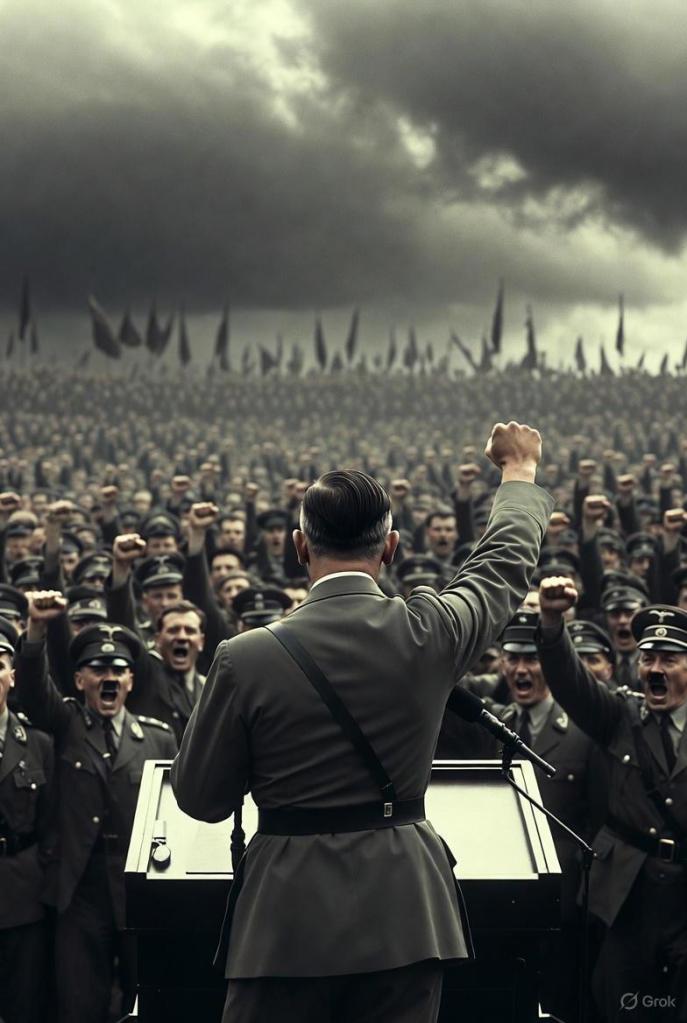
Disclaimer: “Nazi sympathizer” is an over-used label, in my opinion. It’s often confused with empathy, and when it is, it inherently suggests that we shouldn’t try to understand the motivations of people who committed some of the worst atrocities in history. I will state, for anyone who is confused, that I do not align with or condone the despicable acts of the Nazi regime. I have no hate or disdain in my heart for the Jewish people who were senselessly murdered under Nazi rule, or any other race or creed of people, for that matter. The intent of this piece is not to minimize or excuse these acts , but to examine the social conditions that were present at the time, and reflect on patterns we see in society today. If we want to avoid a particular destination, it’s helpful to know which roads lead there.
Hitler is the most universally recognized embodiment of tyrannical evil in the modern world. We are taught to fear the idea of someone like Hitler, who could seize an otherwise good society and lead it into ruin through personal charisma and malice alone. The storyline of one evil man corrupting an innocent nation is comforting, because it locates all the blame in a single monster. It’s also dangerously simplistic and arrogant. It gives far too much credit to one individual and infantilizes an entire population.
In every other domain of catastrophe (wildfires, plane crashes, financial meltdowns, etc.), we obsess over root causes and contributing conditions. With wildfires, for example, assessments are made about overgrowth, dry conditions, weather anomalies, etc. We don’t just conclude that such a massive, destructive fire must have been started by a uniquely powerful match. In this regard, if we view Hitler as the fire that swept through 20th century Germany, it’s paramount that we examine the forest of dried timber that was the Weimar Republic.
Peak Social Freedom
After Germany’s defeat in World War I, the Allies forced the abdication of the Kaiser and replaced the monarchy with a liberal democracy: the Weimar Republic (1919–1933). For a brief moment, Weimar became arguably the most socially progressive society on earth.
Women gained the vote. Divorce laws were radically liberalized. Artistic expression exploded in ways that shocked the old world. Feminism, contraception, and even abortion entered mainstream conversation. Berlin became the undisputed capital of avant-garde art, cabaret, and sexual liberation.
Yet this era of “progress” carried a dark underside that turned liberation into a societal powder keg.
A culture of individualism replaced conformity and collective traditionalism, and relativism gained popularity in universities, leading many to question long-standing moral beliefs. Prostitution was not merely legalized; it became ubiquitous. In the 1920s, Berlin alone had an estimated 100,000-120,000 prostitutes in the city. Pornography flooded the streets. The “New Woman” who could cut her hair short, smoke in public, work, and claim sexual autonomy became an iconic figure, but post-war economic misery and a severe gender imbalance (millions of men died in the first world war) left many women with few viable options to support themselves. Prostitution gained palatability as a means of income in a society that no longer condemned it.
Women didn’t corner the market on prostitution, though; young men joined the trade too. Berlin’s thriving gay, lesbian, and transgender scenes were among the most explicit and visible in history. By the late 1920s a single news kiosk might carry as many as 30 homosexual publications. In 1919 the gay Jewish physician Magnus Hirschfeld founded the Institute for Sexual Research, which aimed to aggressively promote the growth and acceptance of homosexuality and transgenderism through public education and what was then termed “social engineering propaganda”. The institute performed the world’s first gender reassignment surgeries in 1930 and popularized the idea of a “gender spectrum”; a concept later dismissed as pseudoscience, only to resurface in modern culture decades later.
Decadence reigned. Nightlife ran on cocaine and morphine. Violent crime soared; homicide rates nearly tripled (from ~4.5 to 11–12 per 100,000). It’s difficult to discern how much of the rise in violent crime was driven directly by the cultural shift, or at least by a specific part of it. Sources vary in regard to the cause of the crime increase, but one factor seems to be indisputable: a significant increase in political murders. Weimar experienced massive waves of protests, demonstrations, and riots during the 1920s and early 1930s. While social liberalism was on the rise, many viewed the establishment as still too conservative. Left-wing groups like the Spartacists tried to ignite a Bolshevik-style revolution; the Bavarian Soviet Republic actually controlled Munich for 4 weeks. Groups like the Freikorps were hired by the democratic government to crush communist uprisings, but were disbanded in 1920-1921 (some members later joined the Nazi SA)
Economic collapse
The degradation was not only cultural. Hyperinflation, brought on by severe war debt and reparation payments reached its peak in 1923: A loaf of bread cost 3,000 marks in July, 1.5 million in September, and 3 billion by November. Money literally lost value by the hour. Salaries were paid twice a day so workers could rush out and spend them before prices rose again. The middle class was wiped out overnight.
A new currency stabilized things in 1924, but the reprieve lasted only until the 1929 Wall Street crash, when American banks abruptly called in short-term loans to Germany. Unemployment skyrocketed past 30%.
The Nazi Solution
Into this chaos stepped a party that offered security, order, jobs, moral purification, and national pride. The Nazis did not have to invent widespread hatred of Weimar decadence, they only had to promise to end it. Street crime, pornography, prostitution, drugs, communism, degenerate/nihilistic art, gender experimentation – the Nazis promised to sweep it all away with ruthless efficiency.
Exhausted and humiliated by widespread social degeneracy and economic misery, millions of ordinary Germans concluded that radical measures were justified if they restored stability and dignity to the nation. On January 30, 1933, Adolf Hitler was appointed chancellor, entirely legally, by a political establishment that believed he was their best option.
A Repeal of Liberalism
The recoil against the social tendencies of Weimar began immediately. In 1933, Nazi students destroyed the Institute for Sexual Research. Its entire library, consisting of over 20,000 volumes on sexuality, gender, and homosexuality was burned. Book burnings were done as public demonstrations, with clearly stated intent: symbolic purification of German culture, public demonstration of power and unity, and the creation of a new, uniform national culture. The displays served not only to eradicate opposing ideologies, but also to intimidate and silence the opposition. Other books that were burned included works of the Jewish, Marxist/communists, liberal socialists, and anarchists, as well as any pieces considered sexually explicit and degenerate.
Blaming Jews
While the government in Weimar was mostly non-Jewish, Jews (who were less than 1% of the population) were disproportionately represented in media, film and arts, as well as higher education. The Nazis used this to place the blame for social corrosion solely on the Jewish community. They also pushed the “Stab-in-the-back” myth – a conspiracy theory that blamed Jews and leftist politicians for Germany’s surrender in the first world war. Because no enemy soldier had set foot on German soil, and wartime propaganda had hidden the true military situation, millions were stunned by the 1918 armistice, and readily believed the army had been “stabbed in the back” by Jewish revolutionaries and profiteers.
Parallels with Modern Society
Are we living in a modern-day Weimar Republic? Not exactly, but there are definitely comparisons to be made. A significant number of the socially progressive ideas being promoted in our society today originated there. Hyper-sexualization, drag culture, transgender studies, identity politics, degenerate art, pornography, extreme sexual liberalization , culture war rhetoric, critical theory, and even some modernist architectural designs are rooted in Weimar. When the Nazis took over and began their social purge of Jews and Marxists in Germany, many of the most influential intellectuals of the time fled to the United States and continued their work in US institutions. The Institute for Social Research, a predominantly Marxist institution in Frankfurt, fled Germany and re-established itself at Columbia University in New York. This phenomenon was not limited to one university, though. It is estimated that, during this time, over 2,000 intellectuals migrated from Germany to the US and cross-pollinated American campuses with Weimar’s blend of Marxism, psychoanalysis, and social critique.
There are some differences in our society, of course. We are not (at least yet) experiencing economic turmoil on a scale anywhere near what the Germans lived through. Our society is not as young, and hasn’t experienced the gender balance upset caused by the massive German male casualties in the first world war. However, we do have some societal issues that may narrow these differences…
Young Men in the Modern US
“He alone, who owns the youth, gains the future.” – Adolf Hitler
The question is often asked: Why don’t traditional conservatives riot and/or revolt? An obvious answer is that they have too much to lose to risk being arrested, harmed, or face social reprisal. Traditional conservatives have families, jobs, homes, and an established life they don’t want to lose. That is rapidly changing among a younger generation that is farther right than generations before.
Consider what the social and economic landscape looks like to a young man in the US. Today’s high school graduate likely left adolescence right around 2020, a period in which the country seemingly went crazy. Social interactions were sparse, as COVID lockdowns and school closures left kids at home, with little discourse and connection outside the internet. Identity politics moved to the forefront. Cities were burned, people were attacked, and riots were orchestrated with little consequence, all while young white men were told that they were the problem. A war on “whiteness” became mainstream as media outlets echoed the claims of fringe political actors. This all became a catalyst for young white men to be radicalized into their own form of identity politics.
At the same time, housing prices skyrocketed, and inflation reached levels unseen in generations. Today, the average first-time home-buyer is 40 years old. Hyper-competitive internet dating and the emergence of platforms like Onlyfans have left many young men feeling inadequate in finding a mate. Statistically, more young men today are sexless and alone than any generation in over 100 years. It’s not a leap to say a large portion of the population may soon have no family, no house, and no established life they are afraid to lose. Social reprisal means little to the incel crowd, who already see themselves as pariahs.
A Possible Liability
Whether you personally see our current society as degenerate or not is irrelevant; the foundation is certainly there for many to perceive it that way. The presence of degeneracy in society results in a small portion of the population who enjoy the decadence, while a large portion of the population are unhappy with the breakdown of traditional social roles. Considering the social similarities between our present society and that of the Weimar Republic, a rising class of young men entrenched in identity politics, and increasing financial frustration and hopelessness in younger generations, I think it’s reasonable to be concerned. A political candidate who promises social conservatism combined with fiscal liberalism could easily gain overwhelming support – support that might be willing to overlook some obvious pitfalls.
Final Thoughts
A lesson worth taking from all this is one of both humility and responsibility. None of us are immune to the conditions that give rise to destructive authoritarianism. A healthy society therefore needs a certain moderation that its citizens freely choose; not one that must be imposed by the state. Freedom itself is not the problem. The problem is a sudden, extreme disparity between rapid social change and the legitimate human need for continuity, belonging, and meaning. Traditional sources of meaning (family, faith, nation, gender roles) have been core fundamentals in forming the greatest societies in human history. These institutions deserve far more deference than intellectual fashions whose long-term effects remain untested. Great caution, not celebration, is the wiser response when we contemplate trading the proven for the merely novel.

Leave a comment