Social media has been littered with claims that US Attorney General Pam Bondi said something to the effect of this: “If everyone in the Epstein files were prosecuted, the whole system would collapse.” While the exact wording remains unverified and without clear sourcing, the underlying sentiment that mass prosecutions could risk destabilizing institutions has had a profound effect on the public’s opinions around redactions, withheld materials, and the DOJ’s recent handling of the files.
What is your reaction to this alleged statement? Does it bother you; perhaps even anger, or disgust you? If this statement caused a spike in your blood pressure, you’re not alone – It pissed a lot of people off. Countless posts have been made, memes have been created, virtues have been signaled. The internet seems to be unanimous on this one: We cannot allow people who commit heinous crimes to go unpunished. If prosecuting offenders causes a systemic collapse, so be it. After all, who wants to live in a world with a two-tiered justice system that allows the privileged to act with impunity, no matter how immoral their transgressions?
My emotional response is in line with this reasoning. I’m not sure an evil exists greater than one that seeks to exploit the vulnerability of our youth. I believe we should protect our children and our loved ones at all costs, but the modality of that protection may not be as black and white as it seems, and I’m not sure “so be it” is the correct response to the prospect of systemic collapse.
The Trolley Problem
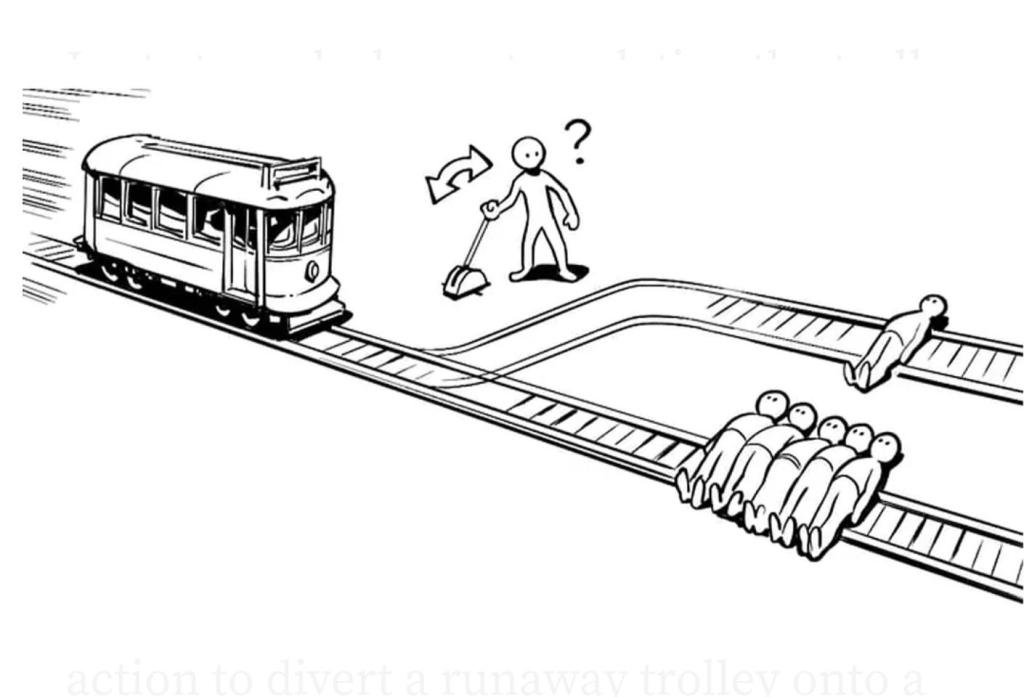
You may be familiar with The Trolley Problem; it’s an ethical thought experiment that goes something like this: A runaway train is heading down a track, approaching a section where there are 5 people on the track. You happen to be standing next to a switch, that when activated, will divert the train onto a second track, away from those 5 people, saving them from certain death. However, there is 1 person on the second track. By flipping the switch, you kill someone who otherwise wouldn’t have died. What do you do? Do you choose the option with the best outcome, or stick to a moral code that prohibits you from causing someone’s death?
To most, this is easy. It demonstrates the philosophical principle of utilitarianism, which argues that the morally correct decision is the one that maximizes well-being for the greatest number of people. 90% of people would choose to flip the switch and save the 5, even if achieving that outcome means condemning someone else to death. It’s only easy, though, because it’s not real life. It’s impersonal enough that it doesn’t elicit an emotional response. A slight variation of the problem exists that changes perception for some: Imagine the same scenario, but this time, you’re standing on a bridge that spans across the track, where the train passes below. There is no second set of tracks, but there is a very large man standing next to you. If you push the man off the bridge, his body will land on the track and stop the train, saving the 5 people. Do you do it? In this variation, only 10% of people say it’s ok to push the man off the bridge. From a utilitarian view, nothing has changed – you’re sacrificing 1 to save 5. However, the act of pushing someone off a bridge creates an emotional response that somehow seems more immoral to some.
How This Relates
The trolley problem presents a philosophical dilemma that the human race has never completely come to terms with. Most of us think in reductive terms of choosing between right and wrong, as if those are the only two options. The truth is far more nuanced, and a bit of good and bad exist in nearly every choice we make.
Is the Epstein dilemma relatable to the trolley problem? Is it possible that this has been covered up for the last 20 years because the fallout may have a greater negative impact to society than the cover-up? If you are drawn to emotional thinking over logic, you might feel like I’m creating a wildly false equivalency here – suggesting that allowing oligarchs, politicians, and others to go unpunished is somehow a good thing. Relax – I’m not. I don’t reference the trolley problem to suggest what is or isn’t good, I do so because it forces us to think about how to choose when there are no good choices.
Caveats
Congrats if you’ve made it this far without presuming I’m a crazy person who seeks to defend elites. Let’s get a few things out of the way:
- Those with money, influence, and power shouldn’t be able to act with impunity. Anyone who takes part in the sexual exploitation of underaged people should not be allowed to live in our society.
- My impression of Pam Bondi has not been a favorable one, and I don’t trust her judgement on much, including this. It’s quite possible that prosecuting those implicated could be done without a complete collapse of our system, and this is just a matter of protecting oligarchs. My intention is to not suggest either way, but to explore the idea of what the implications could be if her alleged statement was true.
- This is not an issue of political party, regardless of how much you want it to be. Jeffrey Epstein was arrested in 2006 and convicted of sex crimes in 2008, then had further charges brought against him in 2019, where he died awaiting trial. Both political parties have held power and been resistant to act.
Prosecuting the Guilty on a Large Scale
In the late 18th century, during the French Revolution, there was a period known as The Reign of Terror. At the time, revolutionaries sought to purge corrupt aristocrats and anyone suspected of betraying the republic, and set out to do so. What was sold as a morally just movement to root out enemies of the people spiraled out of control and lead to large-scale suffering. Accusations became less and less justified, and often originated from anonymous sources. Trials were rushed and sometimes even non-existent. Death sentences were based on vague moral proof and accusations. In the end, ~17,000 official executions took place, and 10,000-20,000 more died in prison. It’s important to note that contrary to initial stated intentions, the majority of victims were commoners, not aristocrats. The terror destabilized the public, eroded trust, and contributed to hyperinflation, food shortages, and widespread suffering.
Another important period took place in the early 20th century Soviet Union, where Kulaks (perceived as wealthier peasants) were targeted by Stalin’s regime as class enemies. This involved arrests, executions, and deportations to settlements in Siberia. Historical accounts cite 300,000-600,000 deaths among kulaks and their families, but that was just the beginning of what would become an even larger epidemic. Kulaks were targeted in part because of their ability to be profitable farmers. Their executions and removal led to the ensuing Soviet famine, causing mass starvation and the death of an estimated SEVEN MILLION people. What was proposed as an opportunity for the poorer class ultimately led to unfathomable amounts of death among the poor.
Are these examples the same? Of course not. Both are far greater in magnitude than what we are discussing here, and I don’t point to them as instances that can be taken synonymously with potential prosecutions from the Epstein files. Yet, they are relevant examples.
The first demonstrates how the crosshairs can easily shift from the guilty, privileged class to the often not-guilty common man. If the people on this list have so much societal power, do you think they will just accept their punishment? It seems more likely that this would be used as a political weapon than a means for justice, especially when the most powerful people control the narrative.
The second illustrates the possibility of unintended societal consequences from large-scale prosecution of people in positions others depend on. In the case of the Soviets, taking out the people who were proficient farmers caused mass starvation. In the case of the Epstein files, it’s tough to say what the fallout could be. Hypothetical cases can be made for circumstances that would cause economic collapse, a power vacuum, or international conflict. Conversely, this could be a situation where such extreme results aren’t as likely as they’re made out to be, similar to the Enron scandal in 2001 – at this point we don’t know.
Unintended Consequences
It’s natural that we strive to protect the innocent, the unfortunate, and the vulnerable – and that’s a good thing – at least it should be, right?
It’s definitely good that we feel that way, but it doesn’t always lead to the best outcome. Too often, our attempts to protect specific groups or individuals not only fail, but lead to unintended consequences that reach far beyond the scope of the group we intended to help. This can be observed widely across society and politics at any given time. No child left behind, the participation trophy movement, gender dysphoria accommodation, welfare programs, and no-fault divorce laws were all aimed at protecting a small portion of the population, but arguably didn’t help those intended, and some may have had a much larger net negative impact on society.
This doesn’t mean we should ignore those in need of protection, it just suggests we consider a more comprehensive view of the impact our actions have. Protective actions are only good when they: a) actually protect those in need, and b) don’t result in harming others to a greater degree or scale. Allowing a train down the path that saves the life of one man is fine, but if we focus too much on saving that one man, we may not notice the 5 who are on the other track.
What Can We Do?
Wealth, power, and influence can undoubtedly lead to unchecked corruption, and if we don’t find a way to counter these things, it’s fair to assume that the problem will only get worse. Something must be done. Should there be prosecutions? Sure, but I’m not optimistic about the scope or integrity of them. The Epstein files have led to broad speculation, to the point that it’s difficult to discern what’s actually real. Some of the files consist of unsubstantiated anonymous tips, even after Epstein died. Some are ridiculously hard to believe.
I think it’s likely that Jeffrey Epstein spent his life entrapping some of the most powerful people in the world, in an effort to gain wealth and influence through blackmail. Some speculate he may have worked with or for various governments and institutions who used him as a resource for global influence. If this is the case, it makes prosecutions a delicate matter, as there is a potential for enormous domestic and international fallout when these people are exposed. This could result in prosecutions being shifted to political enemies and sacrificial scapegoats – allowing the guilty walk away free. While justice is necessary, a witch hunt driven by public outrage could do more harm than good.
What might be a safer way to move forward? One idea includes a phased, evidence-prioritized approach; consisting of independent and bi-partisan review panels, focusing only on cases with clear collaboration from living victims, and evidence beyond the shadow of doubt. This could mean a high burden of proof, but limiting reach to only those who are irrefutably guilty of serious crimes would mitigate political malice and overreach. Another approach might be to focus on civil remedies and victim compensation over criminal action. This could provide tangible justice and deterrence without relying on criminal trials that risk stalling or being weaponized.
In the end, prevention may ultimately prove more effective than retroactive mass prosecution. Prevention could come from independent audits of intelligence operations that might enable blackmail, more accountability for funds allocated to discrete destinations, and electing leaders who prioritize integrity, morality and wholesome values above partisan loyalty.
What do you think is the best approach?