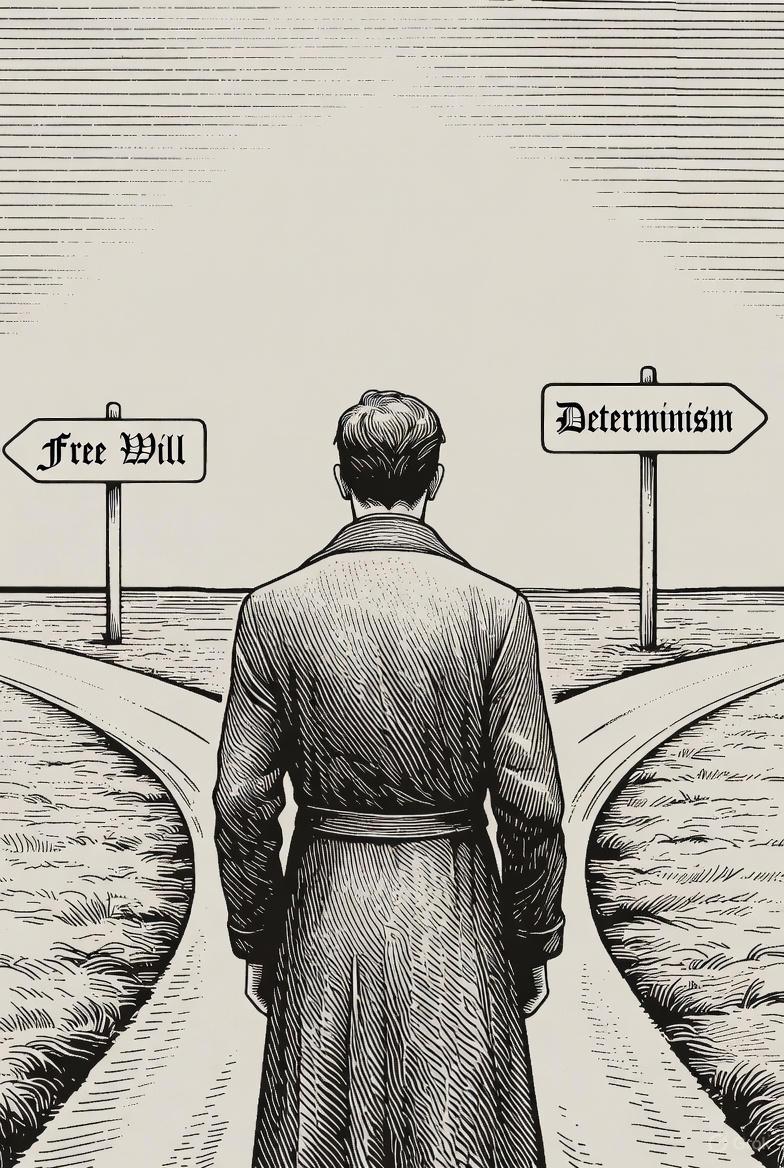
Do we have free will? For many, “free will” is the notion that we have the ability to make our own decisions, and the freedom to act upon them. This is often just an acknowledgment of will itself, not a claim that our will is completely free. Free from what – determinism, external coercion, a higher power? A deeper dive into that question asks where that will comes from in the first place, and if there are ever legitimate exceptions to the responsibility we attach to the principle of free will.
Acquired Sociopathy
In 2012, a man with no criminal record suffered a severe traumatic brain injury in a motor vehicle accident, with focal damage to the prefrontal cortex. Within a month, he committed an impulsive murder during a minor altercation. Neuropsychological tests showed significant deficits in moral reasoning and impulse control directly attributable to the accident. Does this mean he should be treated differently? Was the act of murder completely of his own free will, or were there circumstances beyond his control that contributed?
In 2000, a 40-year-old Virginia school teacher with no prior history of sexual deviance suddenly developed intense pedophilic urges. He began collecting child pornography and inappropriately propositioning women, among them, his own stepdaughter. He was convicted and sent to prison, where he complained of headaches. An MRI revealed a large orbitofrontal tumor. After surgical resection of the tumor, the pedophilic behavior vanished completely. Seven months later, the behavior returned, and tests revealed that the tumor had regrown. Following a second resection, the behavior disappeared again. This demonstrates, once again, that physical characteristics of the brain can dramatically alter mental function.
Cases like these (and dozens like them) have established the existence of a syndrome known as acquired sociopathy (sometimes called frontal-lobe syndrome), in which damage to the prefrontal or orbitofrontal cortex dramatically lowers the threshold for impulsive violence or sexual deviance in previously normal individuals. This concept has been used in court to mitigate punitive measures, supporting the belief that defendants may not bear full moral responsibility for their transgressions, potentially caused by a pathological condition beyond their control.
Disruptors in Pre-birth or Early Life
Brain anomalies are not limited to tumors and physical accidents, though. Numerous congenital and early-life conditions are strongly associated with violence and anti-social behavior.
Conditions present at birth or developed very early, such as malformations or damage to the orbitofrontal/ventromedial prefrontal cortex, early white-matter disorder, amygdala dysfunction, and fetal alcohol spectrum disorder, all correlate with significantly higher predispositions to impulsive aggression.
We label certain patterns as “conditions”, but they’re simply variations along a spectrum, visible only because they stand out from the statistical norm.
A Product of Nature
Genetics and the prenatal environment shape our neural architecture, and thus our capacity to process information, regulate emotions, and inhibit impulses; long before we have any awareness or agency. For example: several studies have demonstrated that IQ is mostly heritable in adults. A person with a 70 IQ cannot “will” themselves to an IQ of 130 any more than a 5’5″ person can will themselves to 6’5″. They didn’t get a vote in their IQ potential at birth, either.
The same principles apply to temperament. Tendencies toward aggression, neuroticism, preference in taste of food, even what time we go to bed all show measurable genetic influence. While the list of genetic variation is nearly endless, the key point is simple: a substantial portion of who we are, how we think, and the paths we are likely to take, is shaped by the biological equipment we received in-utero – equipment over which we had zero control.
Environmental Influence
That said, genetics is not destiny. Much of who we are is in response to the environment we experience throughout our lives. Studies of identical twins raised apart show that significantly different life experiences produce markedly different personalities, habits, and values, despite having identical DNA. Language acquisition demonstrates how experiences at a young age can affect outcomes. A child immersed in a new language before puberty almost always develops an accent nearly indistinguishable from the native tongue, whereas an adult learner rarely does, regardless of the effort they invest. Early trauma, neglect, and other experiences can have equally significant effects on brain function later in life.
The Unchosen Foundations of Choice
We like to think we freely choose our actions, but every choice is made by a brain we didn’t design, shaped by genes we didn’t pick, and experiences we didn’t control. That’s why nearly every religious tradition and ancient wisdom warns against the perils of pride. If our abilities and inclinations ultimately come from gifts we never gave ourselves, taking credit begins to look like arrogance, and a moral plagiarism that demands applause instead of gratitude.
The same logic cuts both ways. If we withhold pride from the lucky because they didn’t earn their good fortune, it’s only fair that we withhold contempt from the unlucky, because they didn’t choose their deficits either. That recognition doesn’t remove accountability, it simply asks us to replace self-righteousness and scorn with something closer to moral empathy.
Back to the Car Accident – Should it Change Our Perspective ?
In cases where people commit violent acts after experiencing traumatic brain injuries, most of us have some level of consideration for their condition. We will perhaps view these situations differently from those in which the assailant didn’t undergo a dramatic re-wiring of the brain. The fundamental problem with this assessment is to assume that an act of “re-wiring” is somehow more profound than wiring that was faulty in the first place. A man who acts violently because he has poor impulse control (or any other character defect) will always have an origin for his shortcomings, whether it be the biological hardware he was born with, the experiences he had in life, or (most likely) both. Do we see someone who was born without legs differently from someone who lost their legs in a accident? Would we expect the first man to walk any more than we would expect the second man to?
Examples of situational influence are endless in life. Studies have shown that victims of childhood sexual abuse are up to 8 times more likely to perpetuate sexual abuse in adulthood, and children raised in violent or chaotic households are many times more likely to repeat those patterns themselves. People who grow up around violence, drug use, theft, and other criminal activity are 12-25 times more likely to become involved in criminal acts. Where one person may be lucky enough to have the intelligence or the guidance to avoid these pitfalls, others will not. There exists no negative or destructive expression in humans that cannot be attributed to circumstance or biology. There is a cause for everything.
A Premise for Action
Once we acknowledge that people are a product of biology and environment, it becomes difficult to hold anyone accountable for anything. Over-expressed empathy can lead to excusing all poor behavior, presenting a clear problem for society.
A solution is to start by understanding that these influences are real, powerful, and deeply unfair. Some of us just got a bad ticket in the lottery of life. That reality deserves compassion, but it must never become an excuse. The only question that matters is this: Is tolerating this behavior good for society? If the answer is no (and it almost always is), then we cannot permit it, no matter how tragic the offender’s backstory.
While this can feel emotionally cold on the surface, it’s actually the most humane path available, and here’s why: Failing to punish misconduct does not merely allow it to continue; it actively breeds more of it. Every unpunished act exposes new people to the very conditions – trauma, normalization, eroded boundaries – that make them likely to repeat the same harm. Each failure to sanction the original offender quietly manufactures both a new victim and, statistically, a future offender. This is known as a positive feedback loop, in which a system’s output amplifies the input, reinforcing and accelerating the cycle. The only way to stop the cycle is to stop the output.
As the saying goes, life isn’t fair. It’s often, in fact, tragic. Despite our emotional disgust in some people’s behavior, it’s logically appropriate to find some sympathy for even the worst offenders. We may wish things had unfolded differently, but the past is fixed. Think of the familiar trope in zombie films: the hero watches a friend or loved one become infected, then is forced to grapple with the impossible choice of putting them down, or risking becoming a victim themselves. In reality, our choices aren’t so stark. We’re not asked to slay zombies to save the world. We do, however, have a responsibility to preserve and protect what’s good in our world – to stop the infection of destructive cycles, and respond to harmful behavior in consistent, principled ways.
